Nazzela
App
A crisis-response marketplace giving communities in Lebanon and similar economies a free platform to monetize their work, access affordable food, and receive financial support that reaches those who need it.

Results before the app even launched
Every metric below was achieved in pre-launch phase — before Nazzela opened to the public.
Lebanon's economy collapsed.
The informal economy didn't.
After the 2019 financial crisis, Lebanon's banking system froze. People lost access to their savings overnight. Unemployment surged, and the official exchange rate became disconnected from reality — making standard international transfers nearly useless.
Yet people kept working. Freelancers, small traders, local craftspeople — informal economic activity kept communities alive. The problem was visibility and access. There was no platform built for this reality.
Broken banking infrastructure
Citizens lost trust in formal financial systems. Cash and informal exchange became the norm, creating fragmented, hard-to-reach markets.
Rising unemployment
Skilled people with valuable services had no way to reach customers at scale — especially outside their immediate neighborhood.
Diaspora cut off from helping
Lebanese abroad wanted to send support, but bank transfers were lossy — money often didn't reach food. There was no controlled way to give.
Food access gaps
Essential goods were increasingly expensive or unavailable in formal retail. Distributed local sellers had no shared storefront.
More than a designer.
A one-person product function.
I joined as the sole designer and took ownership beyond the screen. In a lean team with only developers and a sales unit, I covered every layer of the product — from understanding users to shaping how the business model works.
Product Strategy
- Translated founder vision into product definition
- Prioritized features by impact and feasibility
- Shaped the business model structure
- Built investor pitch decks and presentations
UX & Experience
- User research with freelancers and small businesses
- Information architecture for a feature-rich app
- User flows, wireframes, interaction design
- Validated key assumptions with real users
UI & Delivery
- Built full design system from logo + 3 brand colors
- Produced all final screens and prototypes
- Managed developer handoff and QA
- Ensured vision fidelity in final build
We talked to the people the app was built for
Before committing to the full product direction, we conducted discovery interviews with freelancers, small business owners, and service providers in Lebanon. We wanted to verify that the proposed solution mapped to real pain — and the response was clear.
* Quotes are representative of real sentiment gathered during early discovery conversations with potential users.
One platform. Four interlocking features.
The challenge was building something rich enough to solve multiple interconnected problems — without creating something overwhelming. Every feature had to feel like it belonged.
Map-based marketplace
Users can list services and goods and discover what's available around them — not just as a list, but spatially on a map. Think Airbnb's search, applied to your local economy.
Map search wasn't just aesthetic — it builds trust. Knowing a provider is nearby increases confidence they can deliver quickly. It also surfaces opportunities people didn't know existed in their village or neighborhood.
Essential food marketplace
A dedicated section for affordable essential food, fulfilled through a network of local small businesses acting as pickup points — bringing customers to their doors while giving people access to affordable goods.
Small businesses who host shelves get new foot traffic — a mutual benefit. We're not competing with them, we're a marketing channel. This created early buy-in from 13K+ businesses before launch.
Gift card system
Lebanese diaspora can purchase gift cards specifically redeemable for food in the marketplace. The value goes directly to essentials — bypassing broken bank transfers and ensuring the support lands where it's meant to.
Many donors abroad worry their money is misused. By restricting gift cards to food purchases, we gave donors control and confidence — making giving more likely, more frequent, and more meaningful.
NAT — native reward token
Users earn NAT tokens for sharing the app and growing the community. Tokens can be used to purchase food in the marketplace, creating a circular local economy loop that rewards participation.
Growth through word-of-mouth in Lebanon is high-trust. NAT turns every user into a potential advocate, and spending tokens on food keeps the value circulating within the ecosystem rather than cashing out.
Designed from 3 brand colors,
built into a complete system
Starting with only a logo and three brand colors, I developed the full design language — typography, components, spacing, states — and applied it across every screen in the app.
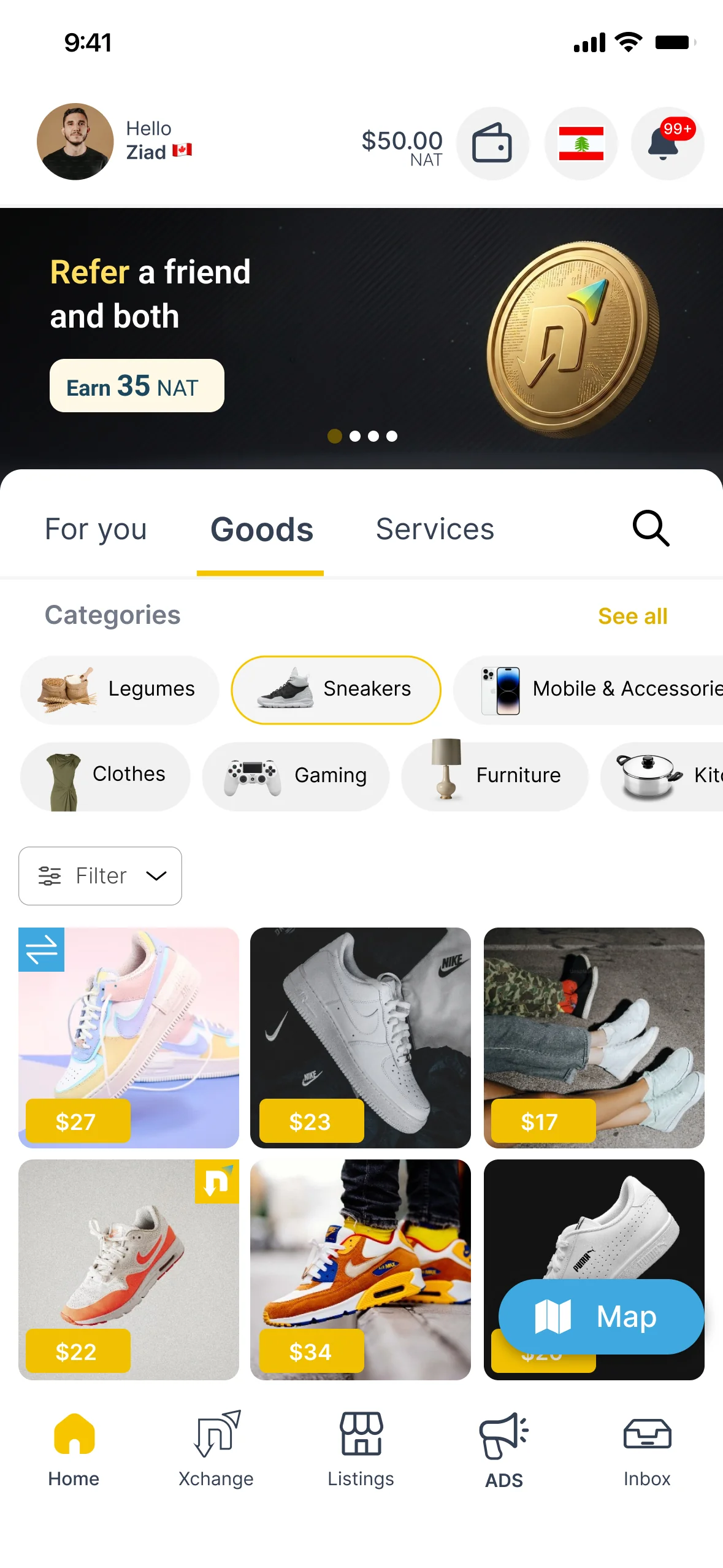
Home & Discovery
Map view + category navigation
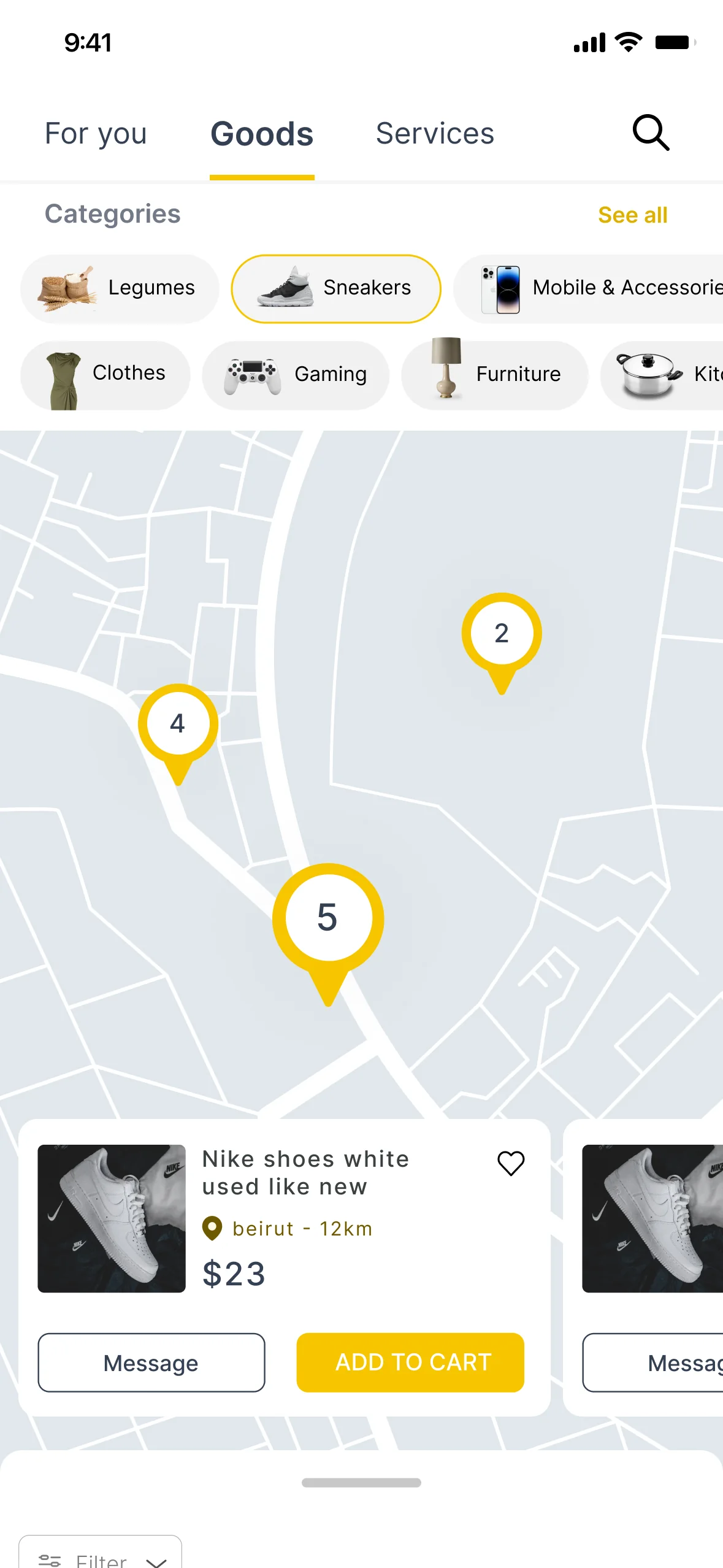
Map-Based Search
Proximity listings with filters
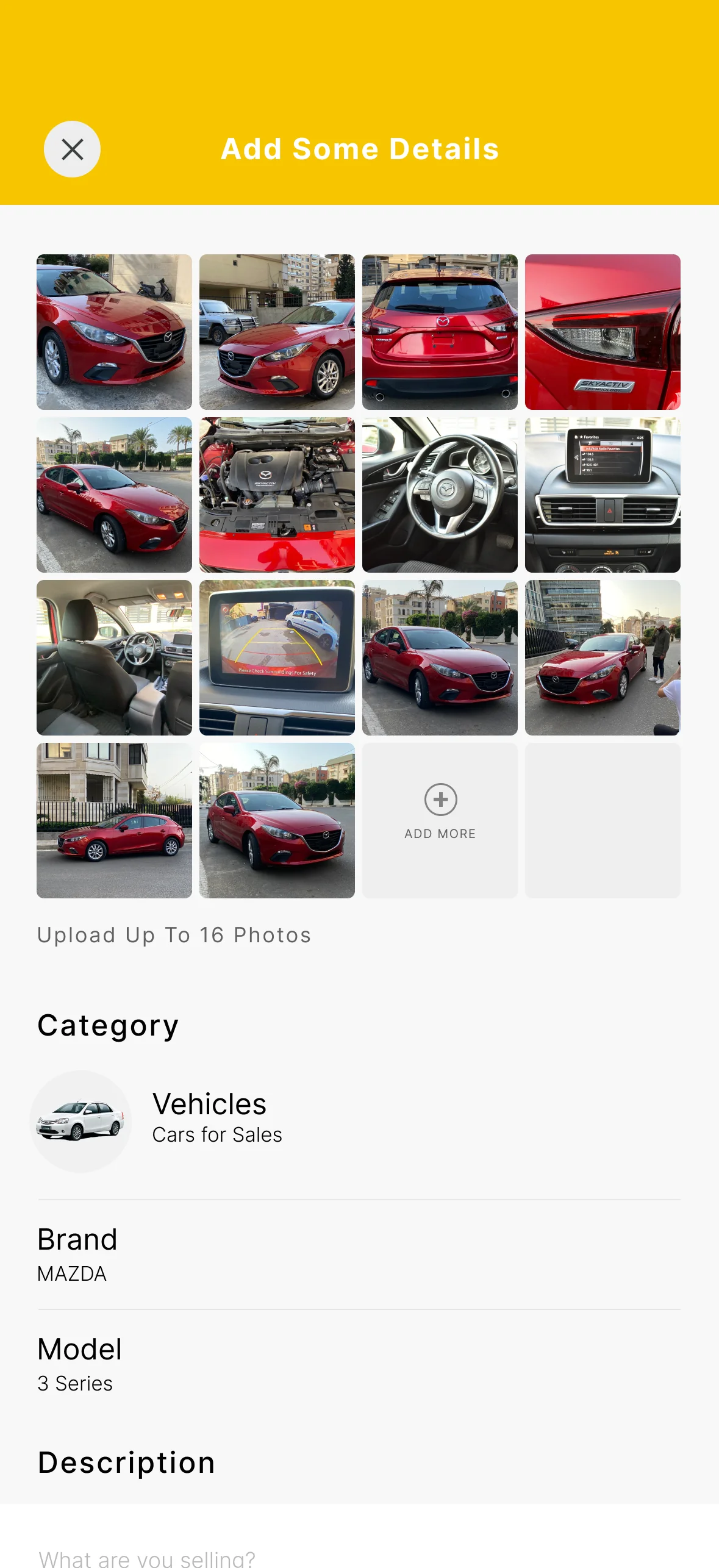
Listing Detail
Service or goods profile page
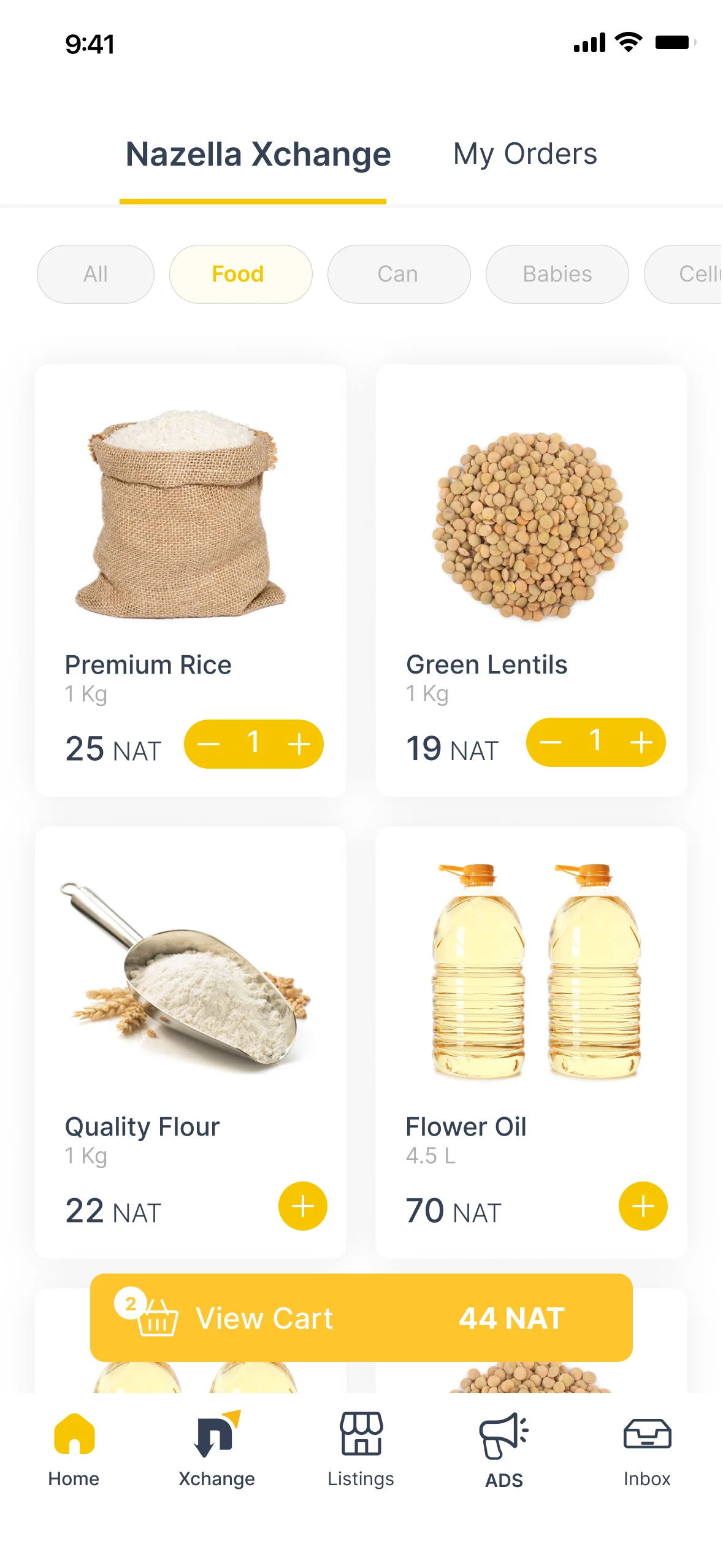
Food Marketplace
Essential goods, pickup locations
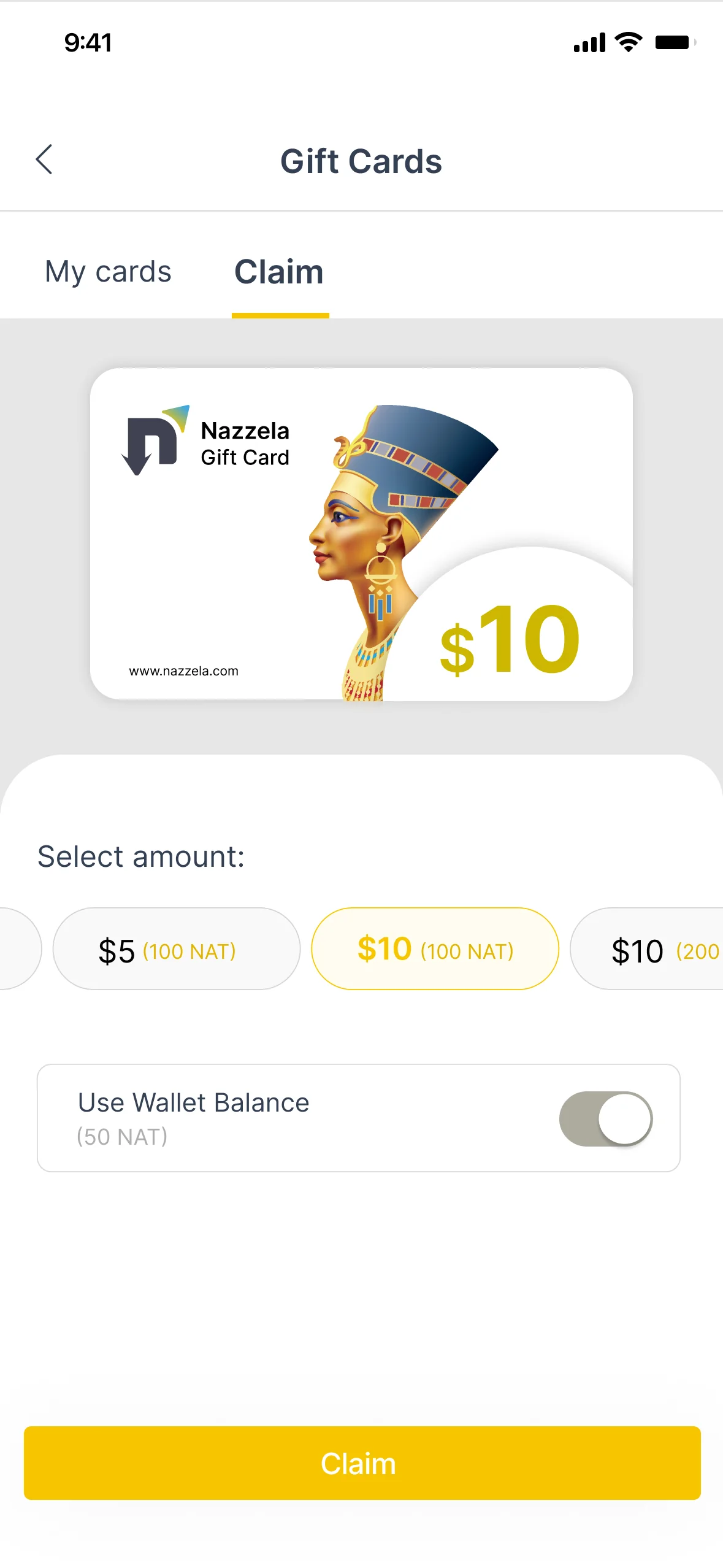
Gift Card Purchase
Diaspora giving flow
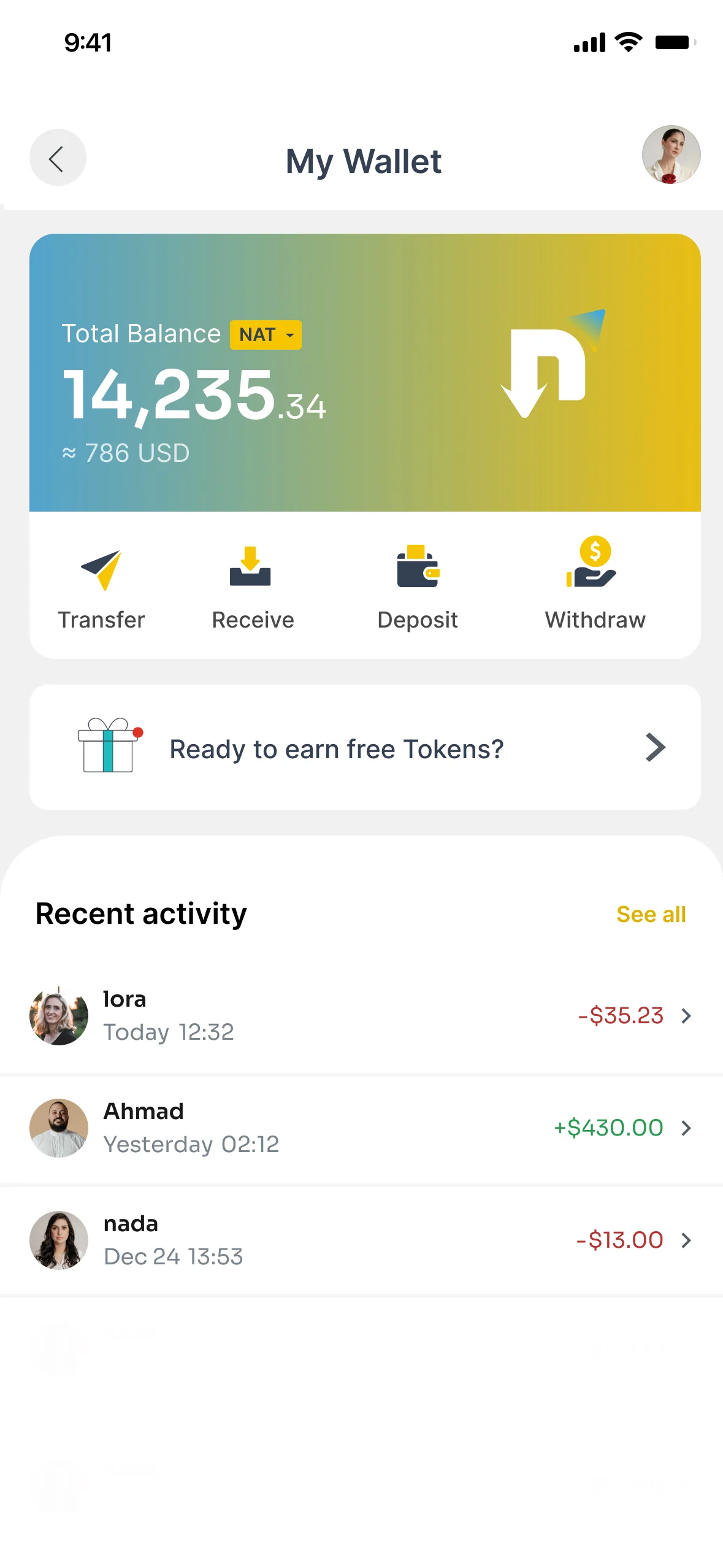
NAT Token Wallet
Earn, track, and spend tokens
← Replace placeholders with final app screens →
The choices that defined the experience
Rich apps require hard tradeoffs. These are the three decisions that shaped Nazzela most — and why we made them.
Map search over list-only browsing
Most marketplaces default to filtered lists. We added a map layer as the primary discovery mode.
Standard approach
Filter-based lists are familiar and fast for urban users — but they assume people know what's available and where. In rural Lebanon, that assumption breaks down.
Our decision
A map reveals what's possible. Someone in a remote village can see three mechanics within 2km they never knew existed. Proximity also signals availability and trust — a nearby provider can arrive faster.
Gift cards restricted to food — not open cash
We could have given donors more flexibility. We deliberately didn't.
Standard approach
Open monetary gifts or general vouchers give recipients more freedom — but they give donors less confidence. When donors can't see where money goes, they often don't give at all.
Our decision
Restricting gift cards to food purchases is a trust mechanism. It removes the donor's doubt — their support goes exactly where they intend. This increases the likelihood of giving and makes Nazzela a preferred channel over bank transfers.
Making the app's richness feel simple, not overwhelming
Four features, multiple user types, one coherent app. The hardest UX challenge.
The challenge
Nazzela serves buyers, sellers, service providers, donors, and future token users — all in one interface. Too much complexity and the core use case gets buried.
The approach
Modular navigation with a clear primary action per context. Each feature accessible without understanding the others. Users land in their mode and depth is optional — exploration is rewarded, not required.
A $100 donation that becomes $200 of impact
One of the most meaningful things I designed for Nazzela wasn't a screen — it was an economic mechanism. Working with the context of active NGOs and international donors in crisis regions, I designed a purpose-driven time-donation model that multiplies the value of every contribution.
The logic: donors want their contribution to matter. By restricting funds to specific activities and doubling the value when contributors reinvest in themselves through advertising, Nazzela makes every dollar work harder — while growing the platform ecosystem at the same time.
Real examples of the mechanism
Reward system is live
The NAT reward infrastructure is already active in the app. The Nazzela team can request services and distribute rewards manually today.
Early donor validation
Donors shown the purpose-donation model confirmed readiness to participate. The concept was positively received before public launch.
Full automation designed
The end state — where a donor selects a purpose and everything flows automatically — is designed and documented. Automation is the next build milestone.
A funded, production-ready product — before day one
Investor Funding
Raised based on the shipped product and the presentations I designed and built — before public launch.
Pre-launch listings
Businesses and individual listings registered by the early sales team, drawn in by the product's value proposition.
Infrastructure
App is fully developed and scaled on AWS servers — in production, awaiting official public launch following a pause due to the conflict in Lebanon.
Stakeholder Reception
Founder, investors, and early business partners expressed strong satisfaction. Small business owners — particularly low-income ones — responded enthusiastically to the shelf model and free access.
The ecosystem we designed toward
Beyond what's shipped, I led deep research into the next phase of Nazzela — a crypto-backed token layer that would turn NAT into a real transferable asset on the blockchain, enabling value exchange across borders without banking infrastructure.
The research phase covered:
Blockchain token architecture
Technical research into making NAT a live crypto token — enabling peer-to-peer value transfer without banks, at the real market rate.
Whitepaper draft
Co-authored a draft whitepaper outlining the token's economic model, utility within the platform, and roadmap to decentralization.
Community funding model
Designed a mechanism where abroad donors fund healthy community activities — food programs, skill-building — through the token, with transparent on-chain accountability.
Connected ecosystem vision
The long-term vision: a single platform where selling, buying food, earning tokens, receiving support, and transferring value are all interconnected — and accessible without a bank account.
What I learned building this
What worked
- Starting from community insight before committing to features
- The mutual value model (shelves = free marketing for small businesses)
- Map discovery as a trust and proximity signal, not just a UI choice
- Controlled giving (gift cards) unlocking a donor segment that otherwise wouldn't engage
What I'd do differently
- Formalize user research earlier with structured interviews and synthesis artifacts
- Build a lighter MVP to test the food marketplace before full development
- Create clearer onboarding paths per user type (buyer vs. seller vs. donor)
- Document design decisions more rigorously during the build — for handoff and future team members